
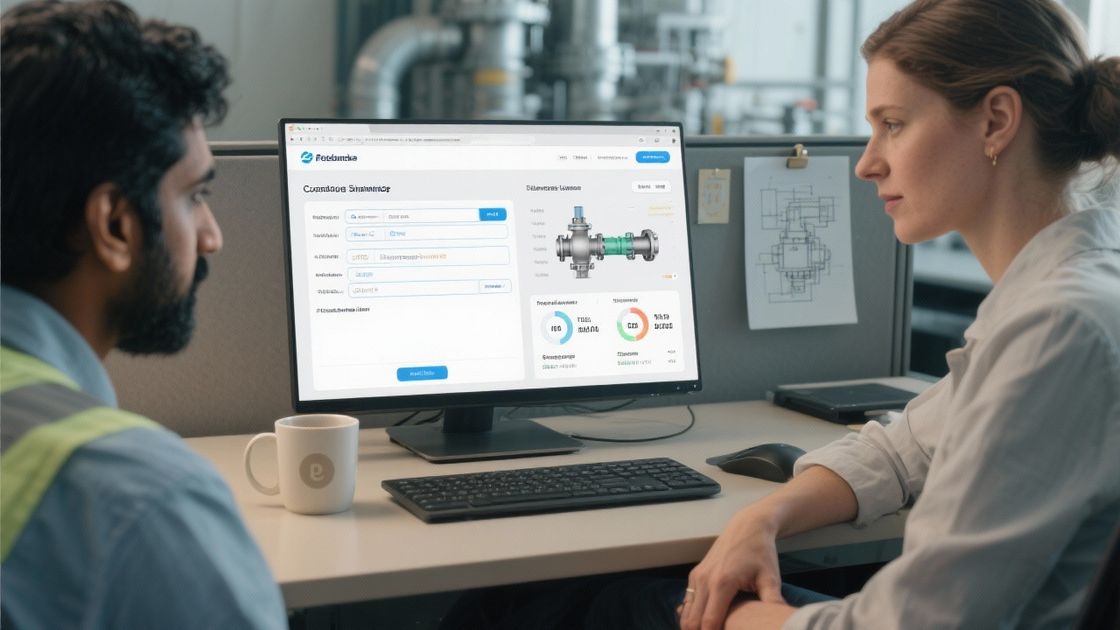
Physical demonstrations feel impossible when your product costs fifty thousand pounds. You ship equipment across the country. You fly technical staff to customer sites. Each trial burns thousands in logistics before anyone decides anything.
Virtual simulators eliminate this entirely. Customers test your product in their browser with their specific parameters and see exactly how it performs for their situation. Zero shipping costs. Zero travel expenses. Zero commitment required from either party.
The Challenge with High-Value Purchases
High-value purchases carry real risk. Customers need certainty before committing. Traditional sales materials provide claims. Customers want proof.
Physical trials provide that proof. They also create friction. Scheduling takes weeks. Logistics cost money. Installation takes time. Many trials never happen because the overhead feels too large.
The prospects who need convincing most never get that hands-on experience. They stay uncertain. The sales cycle extends. Deals fall through because confidence never develops.
What Product Simulators Actually Are
A browser-based simulator replicates your product's core functionality virtually. Customers interact with it as they would the real thing. They adjust settings. They input their data. They see realistic results based on accurate models of how your product behaves.
This differs from videos or animations. The customer controls everything. They test their specific scenarios. They push boundaries. They discover capabilities through experimentation.
A company selling industrial mixing equipment built a simulator showing how different materials blend at various speeds and temperatures. Customers input their actual materials and production requirements. The simulator showed mixing times, energy consumption and final product characteristics. Prospects understood exactly what the equipment would do in their factory before any purchase discussion began.
Why This Accelerates Complex Sales
Customers arrive at purchase conversations already convinced your product works for them. They tested it themselves. They saw it handle their edge cases. The uncertainty that kills deals never develops.
Sales cycles shorten dramatically. The technical evaluation that normally takes months happens during the customer's first interaction with your simulator. They answer their own questions. They build confidence through direct experience.
One client selling warehouse automation systems cut their average sales cycle from nine months to five months. Prospects used the simulator to test their facility layouts and throughput requirements. They arrived at sales meetings already knowing the system would work. Conversations focused on implementation details and pricing.
The Multi-Location Advantage
Physical product demonstrations require people in the same location. Decision makers at different sites never experience your product together. They rely on reports from whoever attended the demo. Information gets lost. Enthusiasm fades.
Simulators reach everyone simultaneously. The operations manager in Manchester tests it. The finance director in London evaluates costs. The technical team in Glasgow explores capabilities. Each stakeholder experiences the product directly. Your champion has better tools for internal selling.
This matters enormously for products sold to large organisations. You rarely get all decision makers in one room. The simulator makes your case to people you never meet. It works when you're not there to guide the conversation.
Building Accurate Simulations
The simulator must behave like your actual product. Customers will test edge cases. They will input unusual parameters. If the simulation produces unrealistic results, trust evaporates immediately.
You need engineers who understand your product deeply. They must translate physical behaviour into mathematical models. The simulation should match real-world performance within acceptable margins. Getting this right takes serious technical work.
A pump manufacturer built a simulator for their industrial pumps. The simulation modelled fluid dynamics accurately. Customers input their specific liquids, flow rates and pressure requirements. The simulator showed pump performance matching what the actual equipment would deliver. Accuracy built trust. Customers believed the results because they could verify them against physics.
Development Timeline and Investment
Simple simulators take three to four months. Complex systems with multiple variables take six to twelve months. Budget fifteen to sixty thousand pounds depending on sophistication.
Compare this to the cost of physical trials. Shipping equipment. Technical support visits. Failed demonstrations. The simulator pays for itself through eliminated trial costs and faster sales cycles.
Track your current demo-to-close conversion rate. Calculate what a 20% improvement would mean for revenue. Most simulators deliver improvements exceeding 20% because they reach far more prospects at far lower cost.
When Simulators Make Sense
Products with configurable parameters work brilliantly. Industrial equipment. Enterprise software. Technical systems. Anything where customer requirements vary significantly between installations.
Standardised products with few variables need simulators less. If your product works the same way for everyone, a good video demonstration suffices. Simulators shine when every customer has unique requirements that affect product performance.
High-value purchases justify the development investment. If your average sale exceeds twenty thousand pounds, a simulator makes financial sense. Lower-value products rarely justify the cost unless you sell thousands of units annually.
Technical Requirements
The simulator must run in any browser. No plugins. No downloads. Customers should access it immediately through a link. Any friction in access means fewer people use it.
Mobile compatibility matters for field staff. Engineers evaluate equipment on tablets at job sites. Sales teams demonstrate capabilities on phones during casual conversations. Your simulator needs to work everywhere.
Response time affects perception. Slow simulations feel unrealistic. Customers lose confidence. The technical architecture must handle complex calculations quickly. Users expect results within seconds.
Data Collection and Learning
Track everything. Which parameters do customers adjust most. Which scenarios get tested repeatedly. Where do people spend time. This data reveals what matters most to your market.
See which features generate the most interest. Notice which configurations customers test. This information guides product development. You learn what capabilities customers actually care about.
Sales teams gain insight into each prospect before conversations begin. They see which scenarios the prospect tested. They understand specific concerns. First meetings become far more focused and productive.
The Competitive Advantage
Most expensive products still rely on traditional sales processes. Physical demos. Site visits. Long evaluation periods. A virtual simulator makes you dramatically more accessible than competitors.
Prospects can evaluate your product at midnight from their sofa. They can test dozens of scenarios without scheduling anything. This convenience matters more than people realise. The easier you make evaluation, the more prospects will actually evaluate your offering.
Your simulator becomes a marketing asset. Prospects share it with colleagues. They demonstrate it in internal meetings. The tool spreads through organisations naturally. Each interaction builds familiarity with your product.
Integration with Sales Process
The simulator should feed your CRM automatically. Track who uses it and when. See which scenarios they test. Sales teams follow up with relevant information based on simulator usage.
Qualify leads through simulator behaviour. Someone testing dozens of configurations shows serious interest. Someone running one quick test might be casually browsing. Sales effort focuses where engagement indicates real opportunity.
Use simulator results in proposals. Show prospects their specific test scenarios in documentation. Reference the configurations they explored. This personalisation makes proposals far more compelling.
When Physical Trials Still Matter
Some customers need physical proof regardless of simulator results. They want to see equipment running in person. The simulator prepares them for that physical trial. They know what to look for. They have specific questions ready. The physical demo becomes more productive.
Regulatory requirements sometimes demand physical testing. Compliance certifications. Safety validations. Quality standards. The simulator cannot replace these. It can reduce the number of physical trials by helping customers determine fit before formal testing begins.
Very conservative industries move slowly on virtual tools. They prefer traditional evaluation methods. Know your market. Some sectors embrace virtual trials enthusiastically. Others remain sceptical.
Measuring Success
Track conversion rates from simulator users compared to non-users. Measure time from first contact to closed deal. Compare deal sizes. Most companies see substantial improvements in all three metrics.
Survey customers after purchase. Ask whether the simulator influenced their decision. Find out what it taught them. This feedback guides simulator improvements and shows actual business impact.
Calculate cost per qualified lead. Physical demos cost thousands per prospect. Simulators cost pennies once developed. The economics shift dramatically in your favour.
Making the Investment Decision
Ask whether prospects struggle to understand how your product would work for their specific situation. Ask whether physical trials create bottlenecks in your sales process. Ask whether you could reach more qualified prospects with lower-friction evaluation options.
When uncertainty blocks sales and trials cost too much, a simulator solves both problems. You trade upfront development costs for dramatically improved sales efficiency and higher conversion rates.
The mathematics work when your product is expensive and your prospects need convincing. That describes industrial equipment, enterprise systems, technical platforms and professional tools. All benefit from letting customers experience the product virtually before committing.
Virtual simulators reach far more people at far lower cost. The accessibility advantage transforms complex B2B sales processes.
Build a simulator. Let customers convince themselves your product solves their problem. The sales process transforms when prospects experience your offering directly.